$55.00 – $240.00Price range: $55.00 through $240.00
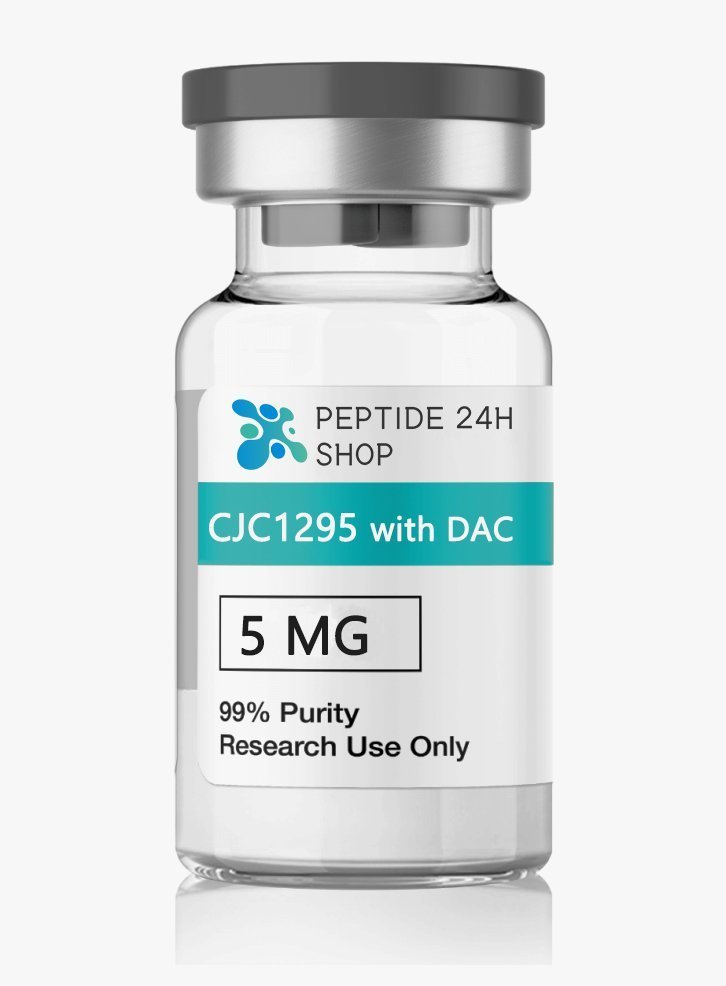
Name: CJC1295 With DAC; CJC-1295 DAC; CJC-1295 with DAC
CAS No.: N/A
Peptide Sequence: Tyr-D-Ala-Asp-Ala-Ile-Phe-Thr-Gln-Ser-Tyr-Arg-Lys-Val-Leu-Ala-Gln-Leu-Ser-Ala-Arg-Lys-Leu-Leu-Gln-Asp-Ile-Leu-Ser-Arg-Lys(Mal)-NH2
Molecular Formula: C165H269N47O46
Molecular Weight: 3647.28
Appearance: White Lyophilized powder
Among research peptides exploring the growth hormone axis, CJC-1295 With DAC (Drug Affinity Complex) stands out as a long-acting analogue of growth hormone-releasing hormone (GHRH). Designed to extend circulation time and improve molecular stability, this compound is of interest to researchers investigating GH pulsatility, IGF-1 signaling, and endocrine regulation.
This article provides a concise scientific overview of CJC-1295 With DAC, how its DAC modification works, how it differs from the no-DAC variant, and key considerations for peptide researchers.
(Informational only — not medical or therapeutic advice.)
CJC-1295 is a synthetic peptide analogue of GHRH (1-29), the portion responsible for stimulating growth hormone release from the anterior pituitary. The “With DAC” designation refers to the Drug Affinity Complex, a chemical modification allowing the peptide to bind to albumin in the bloodstream.
This albumin-binding feature significantly prolongs the peptide’s half-life, maintaining biological activity for several days rather than just hours. The result is a long-acting GHRH analogue capable of producing sustained stimulation in experimental settings.
Researchers value this stability when modeling long-term GH/IGF-1 secretion patterns, comparing them to the effects of shorter-acting analogues or natural pulsatile GHRH activity.
The DAC moiety is a molecular linker that attaches to lysine residues on the peptide, allowing reversible binding to plasma albumin. This creates a peptide–albumin complex that resists enzymatic degradation and renal clearance.
Mechanistically:
CJC-1295 binds GHRH receptors on somatotroph cells in the pituitary.
This activates cAMP signaling, promoting growth hormone release.
The DAC modification maintains systemic presence for up to 6–8 days, depending on study design.
The extended circulation supports more consistent GH pulses, often reflected by increases in IGF-1 levels in research models.
Because of this, the DAC version is often referred to as the “extended-release GHRH analogue.”
| Property | CJC-1295 With DAC | CJC-1295 No DAC |
|---|---|---|
| Albumin binding | Yes | No |
| Approx. half-life | 6–8 days | <1 day |
| Dosing frequency (research) | Lower (e.g., 1–2× weekly) | Higher (daily) |
| Main focus | Long-term GH/IGF-1 modulation | Short, pulsatile GH release |
| Typical research use | Endocrine and peptide stability studies | Acute GH kinetics |
In experimental and preclinical studies, CJC-1295 With DAC has been used to explore:
The kinetics of GH secretion in response to long-acting GHRH analogues.
How albumin-binding modifications affect peptide pharmacodynamics.
The relationship between sustained GH release and IGF-1 regulation.
Potential use in studying metabolic, anabolic, and recovery-related pathways within controlled laboratory models.
It’s important to emphasize that while data from early trials and animal studies are available, CJC-1295 With DAC is not approved for medical use and remains a research-only compound in most jurisdictions.
As with all synthetic peptides used in research:
Work should occur in controlled laboratory environments using appropriate sterile technique.
Lyophilized CJC-1295 DAC is typically stored at –20 °C; reconstituted samples should be refrigerated (2–8 °C).
Proper documentation and labeling are essential for compliance and reproducibility.
Reports in research contexts describe mild transient effects such as flushing or injection-site reactions. However, these observations are not clinical safety data, and human use is not advised outside supervised or approved studies.
Both versions of CJC-1295 target the same receptor system, but the DAC modification defines their difference.
The No DAC version produces rapid, short GH pulses suitable for examining acute signaling events.
The With DAC version creates a long, steady presence ideal for studying extended growth hormone stimulation.
Researchers often compare both to understand how duration of exposure affects downstream pathways like IGF-1 expression, tissue growth, and recovery mechanisms.
CJC-1295 With DAC exemplifies how peptide engineering can modify pharmacokinetics to suit specific research goals. Its albumin-binding design provides a long-acting analogue of GHRH, helping researchers investigate the effects of sustained GH/IGF-1 modulation in experimental settings.
While promising as a scientific tool, its use remains confined to research purposes only. Always source from certified suppliers and follow institutional and regulatory peptide-handling guidelines.