$55.00 – $450.00Price range: $55.00 through $450.00
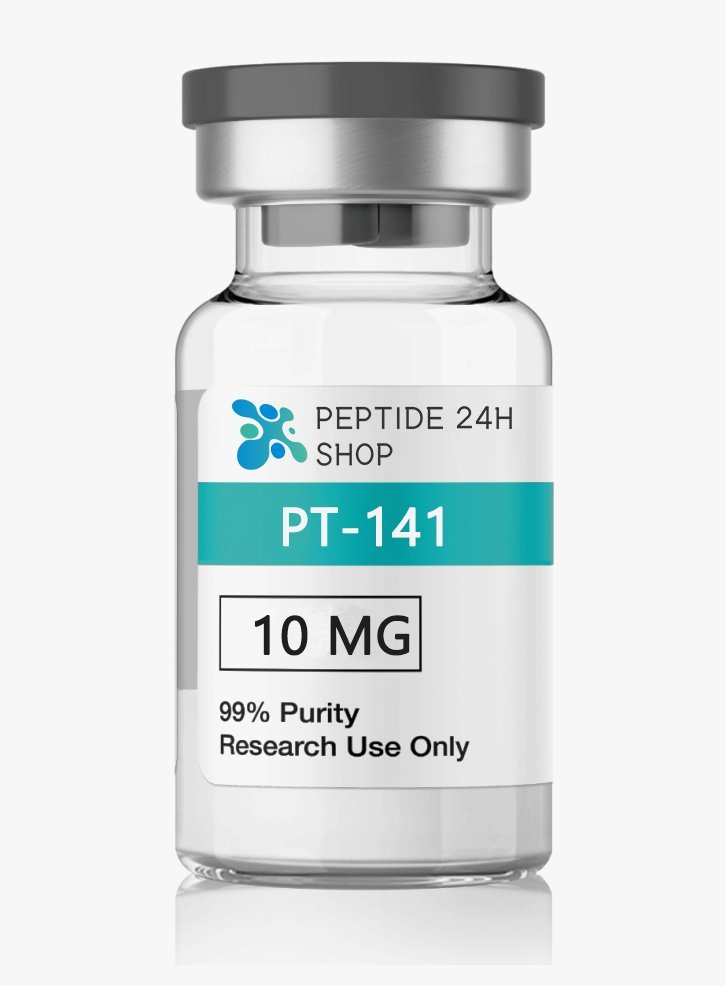
Name: PT-141(Bremelanotide)
CAS No.: 189691-06-3 / 1607799-13-2
Peptide Sequence: Ac-Nle-Asp-His-D-Phe-Arg-Trp-Lys-OH (Chemical Bridge Asp2-Lys7)
Molecular Formula: C50H68N14O10
Molecular Weight: 1025.18
Appearance: White Lyophilized powder
PT-141, also known as Bremelanotide, is a synthetic peptide primarily studied in laboratory settings for its mechanism of action in receptor pathways and cellular interaction studies. Researchers focus on PT-141 for its ability to bind melanocortin receptors and study molecular signaling processes in vitro.
This guide provides a comprehensive ranking of available PT-141 peptides for laboratory research, examining purity, synthesis quality, stability, and documentation, enabling researchers to make informed decisions when sourcing peptides.
⚠️ Disclaimer: PT-141 peptides discussed here are strictly for laboratory research use only, not for human or veterinary consumption.
PT-141 is a short-chain synthetic peptide that mimics melanocortin receptor agonists. It has been investigated in molecular research for its effects on receptor signaling, cellular response, and peptide-receptor interaction assays.
Key attributes of PT-141 peptides for research:
High receptor specificity for in-vitro assays
Chemically synthesized using solid-phase peptide synthesis (SPPS)
Reproducible activity verified via HPLC and mass spectrometry
Researchers utilize PT-141 in studies of:
Peptide-receptor interactions
Molecular modeling of receptor pathways
In-vitro signaling studies
Comparative analysis of peptide analogs
Selecting the right PT-141 peptide for laboratory research requires evaluating purity, synthesis method, stability, and documentation. Below is a global ranking of top PT-141 peptides based on research-grade criteria.
| Rank | Product Name | Purity | Form | Key Features | Research Use |
|---|---|---|---|---|---|
| 1 | PT-141 Peptide A | >98% | Lyophilized powder | Verified by HPLC/MS, batch CoA included | In-vitro studies, receptor signaling |
| 2 | PT-141 Peptide B | 97% | Lyophilized powder | High solubility, stable storage | Cellular assays, peptide-receptor studies |
| 3 | PT-141 Peptide C | >95% | Lyophilized powder | Optimized for receptor interaction | Molecular modeling, comparative assays |
| 4 | PT-141 Peptide D | 96% | Lyophilized powder | High reproducibility, validated purity | Cell signaling studies |
| 5 | PT-141 Peptide E | 94% | Lyophilized powder | Cost-effective, reliable batch quality | Laboratory exploration and pilot studies |
⚠️ Rankings are based on laboratory research criteria: purity, synthesis method, verification, and reproducibility.
High-quality PT-141 peptides should achieve ≥95% purity, confirmed by HPLC and mass spectrometry. Purity ensures reproducibility in experimental assays and accurate data interpretation.
Solid-phase peptide synthesis (SPPS) is the preferred method for PT-141 peptides, ensuring correct sequence assembly, minimal side-products, and high reproducibility.
Peptide stability is critical. PT-141 is typically supplied as lyophilized powder to prevent degradation. For long-term storage:
Store at –20°C (lyophilized)
Reconstituted solutions: aliquot and store at –80°C
Avoid repeated freeze-thaw cycles
Reliable suppliers provide a Certificate of Analysis (CoA), including:
Purity percentage
Mass spectrometry validation
HPLC chromatograms
Documentation is essential for reproducibility and regulatory compliance in laboratory research.
PT-141 is mainly used in preclinical, in-vitro research studies, including:
Receptor signaling assays: Investigating melanocortin receptor pathways
Cellular response analysis: Understanding peptide-cell interactions
Molecular modeling: Comparative studies of synthetic peptide analogs
Peptide-receptor binding studies: Assaying specificity and activity
Its receptor-specific properties make PT-141 peptides valuable for basic molecular research, pharmacology studies, and peptide-based assay development.
Reproducibility: Ensures consistent results across experimental batches
Verified purity: Minimizes variability in molecular assays
Chemical stability: Maintains peptide activity during storage and handling
Research-focused documentation: CoA, HPLC, and MS data enhance credibility
High-ranking PT-141 peptides are essential for accurate laboratory experiments and data integrity.
Proper handling maintains PT-141 peptide integrity:
Lyophilized: Store at –20°C in airtight containers
Reconstituted: Aliquot and store at –80°C
Avoid moisture, light, and repeated freeze-thaw cycles
Use gloves, eye protection, and sterile techniques during preparation
Adhering to these practices ensures reliable and reproducible experimental results.
PT-141 acts as a melanocortin receptor agonist, primarily used in in-vitro studies to understand receptor signaling and cellular responses.
No. The peptides listed here are strictly for laboratory research use and are not approved for clinical or human use.
PT-141 is typically supplied as a lyophilized powder with accompanying CoA and MS/HPLC data to verify purity and integrity.
Research-grade PT-141 peptides should have ≥95% purity, verified by HPLC and mass spectrometry.
Used in cellular signaling studies, receptor binding assays, peptide-receptor interaction studies, and molecular modeling in preclinical research.
PT-141 peptides are essential tools for advanced laboratory research, offering high purity, stability, and receptor-specific properties for in-vitro studies.
Selecting the right PT-141 peptide involves evaluating:
Purity and verification methods
Synthesis technique and batch consistency
Stability, storage, and documentation
Applicability for receptor signaling and cellular assays
With proper selection, handling, and experimental planning, PT-141 peptides provide reliable and reproducible results, making them a cornerstone of peptide-based research and molecular studies.