$75.00 – $299.00Price range: $75.00 through $299.00
Name:?N-Acetyl Semax Amidate; Ac-Semax Amidate; Ac-Semax-NH2
CAS No.: N/A
Peptide Sequence: Ac-Met-Glu-His-Phe-Pro-Gly-Pro-NH2
Appearance: White Lyophilized powder
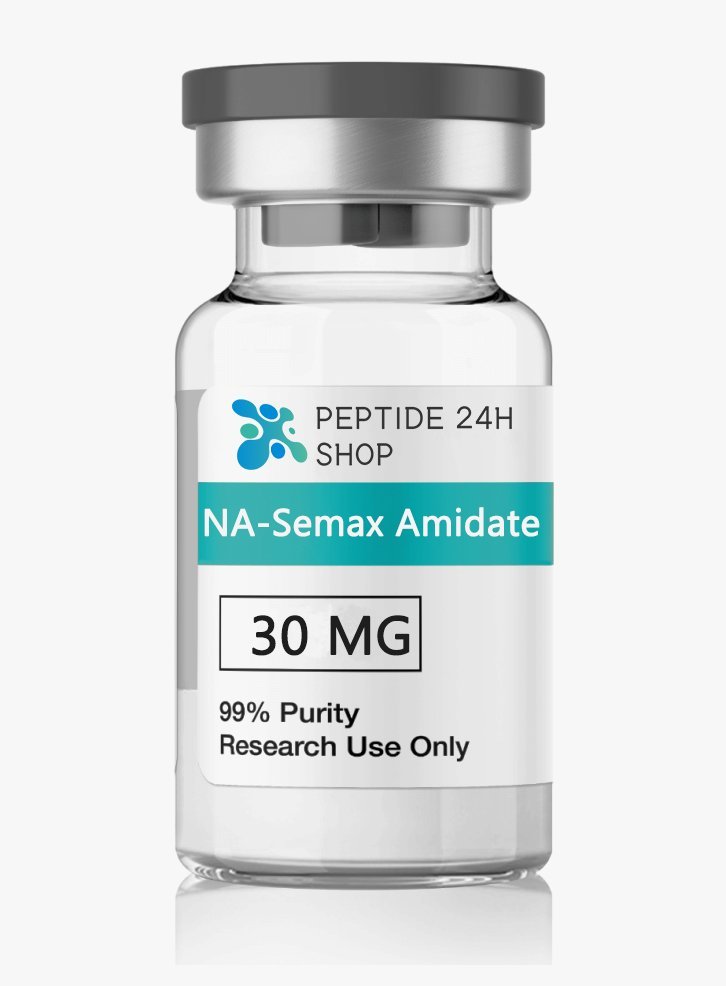
N-Acetyl Semax Amidate (NA-Semax-Amidate) is a cutting-edge synthetic peptide analog derived from the Semax family—a class of heptapeptides developed to explore neuroactive and regulatory peptide mechanisms. Featuring both N-acetylation and C-terminal amidation, NA-Semax-Amidate demonstrates enhanced stability and resistance to enzymatic breakdown, making it a valuable compound for academic and biochemical research.
Peptide Name: N-Acetyl-Pro-Gly-Pro-Gly-Pro-His-Pro-NH₂
Synonyms: NA-Semax-Amidate, Ac-Semax-NH₂
Molecular Formula: C₃₇H₅₆N₁₀O₉
Molecular Weight: ~796.9 g/mol
Peptide Type: Synthetic heptapeptide
Form: Lyophilized powder (research grade)
The dual chemical modifications — acetylation and amidation — improve peptide integrity and allow for greater metabolic stability during in vitro or in vivo experiments.
Semax analogs, including NA-Semax-Amidate, were first synthesized in Russia as part of ongoing efforts to model ACTH (4–10) fragments and their effects on the nervous system. Researchers developed these peptides to explore cognitive regulation, neuroplasticity, and stress-response pathways at a molecular level.
NA-Semax-Amidate builds on this legacy by offering a more chemically resilient version of the original Semax structure—ideal for controlled laboratory research and mechanistic peptide studies.
While not approved for clinical or dietary use, NA-Semax-Amidate has become an increasingly relevant subject in preclinical peptide research. Current studies investigate its role in several experimental areas:
Preclinical evidence on related Semax peptides shows possible modulation of BDNF (Brain-Derived Neurotrophic Factor) and NGF (Nerve Growth Factor), both of which are vital for neuronal growth and survival.
Semax-type analogs are explored for their ability to influence oxidative stress pathways, enhance antioxidant enzyme activity, and potentially modulate adaptive neurochemical responses.
In animal models, Semax derivatives have been linked to enhanced synaptic plasticity and neurotransmission. These findings make NA-Semax-Amidate an interesting target for continued laboratory research into cognitive mechanisms.
Researchers use N-Acetyl Semax Amidate as a tool compound to study:
Peptide degradation and stabilization processes
Neuroactive peptide transport across the blood-brain barrier
Peptide–receptor binding dynamics
Molecular interactions in neurochemical regulation
Its robust chemical modifications make it particularly suited for in vitro and in vivo models requiring sustained peptide presence.
Form: Lyophilized powder
Storage Temperature: −20 °C
Solubility: Water, saline, or pH-neutral buffer
Shelf Life: Approximately 24 months under proper storage
Purity: ≥98% (analytical grade, varies by supplier)
⚠️ Important Note:
N-Acetyl Semax Amidate is for laboratory research use only. It is not approved for human, veterinary, or therapeutic use. Always follow institutional and governmental safety protocols when handling peptides.
As with all experimental peptides, NA-Semax-Amidate is governed by research-use-only (RUO) regulations. It has no FDA, EMA, or TGA approval for human consumption or medical applications. Suppliers must label and distribute the compound strictly for non-clinical investigative purposes.
N-Acetyl Semax Amidate (NA-Semax-Amidate) represents a novel and promising direction in peptide research. With improved stability and potential biological activity, it continues to serve as a valuable model compound in studies related to neurochemistry, peptide engineering, and molecular pharmacology.
Researchers investigating Semax analogs and synthetic heptapeptides can gain key insights into how small structural changes can dramatically influence biological function and peptide dynamics.