$95.00 – $950.00Price range: $95.00 through $950.00
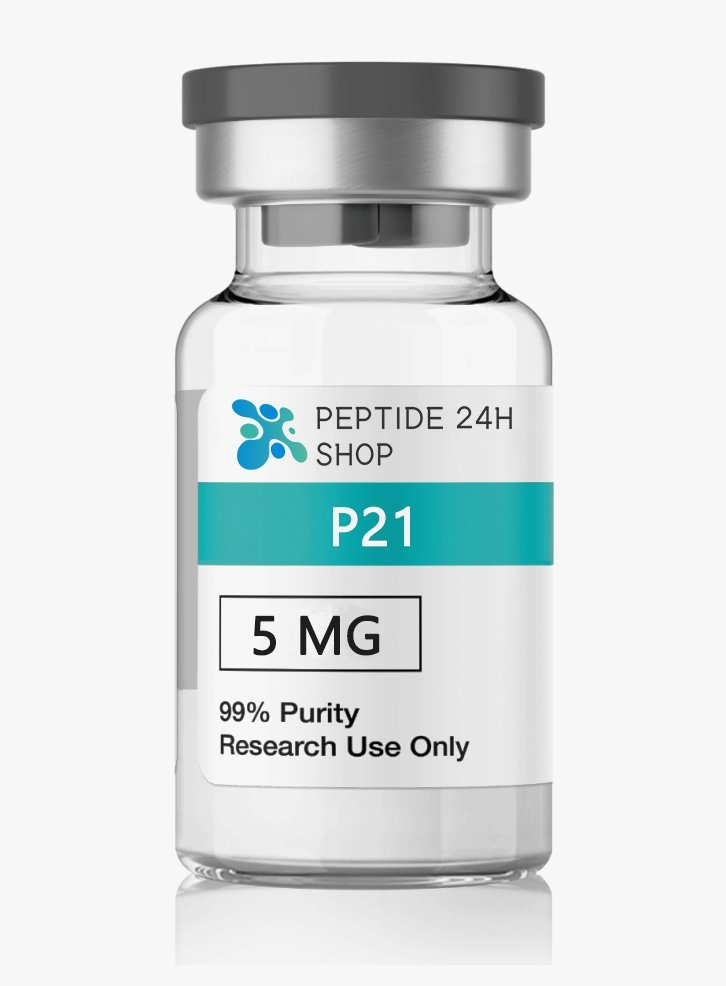
Name: P21 (P021)
CAS No.: N/A
Peptide Sequence: Ac-Asp-Gly-Gly-Leu-Adamantane-NH2
Molecular Formula: C27H42N6O8
Molecular Weight: 578.7
Appearance: White Lyophilized powder
P21 peptide is a synthetic heptapeptide analog structurally related to the Semax family of neuroactive peptides. It has attracted increasing attention in biochemical and neuroscience research due to its structural resemblance to peptides involved in neurotrophic regulation and synaptic plasticity.
Developed through rational peptide design, P21 peptide combines features of Semax and C-terminal fragments of N-acetyl Semax analogs, offering enhanced molecular stability and potential receptor selectivity in experimental models.
As a research-use-only (RUO) compound, P21 peptide is intended solely for scientific and laboratory investigations—not for human or veterinary use.
Peptide Name: P21
Sequence: Ala-Glu-Asp-Pro-Gly-Pro-Gly-Pro-His-Pro-NH₂ (representative structure)
Molecular Weight: ~1700 Da (varies slightly by analog)
Peptide Type: Synthetic neuroactive peptide analog
Form: Lyophilized white/off-white powder
Purity: ≥98% (HPLC verified)
The structural modifications in P21 peptide were designed to improve enzymatic resistance and enhance activity duration, making it an excellent model compound for peptide stability and receptor-binding studies.
P21 was first conceptualized as an advanced derivative of the Semax peptide, aiming to improve upon its bioavailability and neurotrophic potential in controlled settings.
In preclinical research, P21 peptide is used to examine the relationship between peptide sequence and cognitive modulation, including effects on neuroplasticity, gene expression, and oxidative balance.
Its unique sequence allows researchers to study how subtle modifications to peptide chains can influence neurochemical signaling and molecular communication across neural tissues.
Although not approved for clinical use, P21 peptide remains a valuable biochemical tool in:
Researchers use P21 to investigate potential upregulation of BDNF (Brain-Derived Neurotrophic Factor) and other neurotrophic molecules in neuronal cultures.
P21 analogs are being explored for their effects on antioxidant enzyme expression and stress-response mechanisms in cellular systems.
Due to its modified termini, P21 peptide offers improved resistance to proteolytic degradation, making it useful in long-term in vitro assays.
Neurochemical and molecular biology studies
Peptide-receptor interaction assays
Cognitive and behavioral model research (animal or cell culture)
Peptide degradation and stability testing
Its balanced structure and strong backbone integrity make it suitable for studying how short-chain peptides influence cellular signaling and molecular feedback in controlled laboratory environments.
Form: Lyophilized powder
Storage Temperature: −20 °C
Solubility: Water, saline, or neutral pH buffer
Shelf Life: Up to 24 months (lyophilized, protected from moisture)
Usage: Research use only; not for human or veterinary consumption
To maintain peptide integrity, minimize freeze–thaw cycles and reconstitute only immediately prior to experimental use.
P21 peptide is not approved by the FDA, EMA, or TGA for human or therapeutic use.
Distribution must clearly state “for research use only (RUO)”.
Researchers should follow institutional biosafety and handling guidelines for synthetic peptides.
P21 peptide is a next-generation synthetic neuropeptide analog inspired by the Semax family, offering enhanced molecular stability and versatile research potential.
Its unique composition makes it a valuable compound in neuroscience, peptide biochemistry, and molecular pharmacology, serving as a model for studying peptide-induced neurotrophic regulation and peptide engineering.
While not intended for clinical use, P21 peptide continues to advance understanding of short-chain peptides and their biological significance in experimental science.